Showing posts with label food. Show all posts

Tuesday, 31 July 2018

Chilling out in chilli lovers paradise

I don't know the official data, but I suspect the British Isles are home to the highest number of festivals in the world. For one, we are likely to be world leaders in literary festivals - this useful source lists more than 350 such festivals per year, taking place in both big cities and small towns, the length and breadth of Britain. I have had the good fortune to visit the most famous of them all, the Hay Festival, and I am also very lucky to know the lovely people behind one of the newest, yet already very popular, our own Salisbury Literary Festival, but I shall write about it in due course, because it deserves a separate post.
There are also many music festivals, some huge and well-established, such as Glastonbury, and some small, catering to very specific audiences - each genre seems to have a dedicated festival. Some combine music with other arts, or crafts, or food. Then there are food festivals - and we went to one last Saturday.


The Great Dorset Chilli Festival is a chilli lover's dream. As my husband happens to be one, and I also enjoy the flavoursome (though not too hot) dishes he cooks using various types of chilli, we headed to St Giles Park in Dorset with eager anticipation. It is a beautiful location - Grade II-listed St Giles House and the surrounding park belong to the Earl of Shaftesbury. Festivals often take place in stately homes' grounds - they must be a useful source of revenue.


The main star of the show was, of course, chilli, all the different types, from the mildest to the hottest on the Scoville scale. There were many stalls selling all things chilli, from plants to a huge variety of chilli condiments. There was even one with chilli - themed pottery. 

It is remarkable that one ingredient can spawn so many small businesses, and yet most of them were local, based in Dorset, Wiltshire or Hampshire. We chatted to the people running the stalls, and they were all passionate about their products, quite a few proudly displaying their Great Taste awards. The biggest draw and pleasure of a food festival is that you can taste almost everything before you buy it (or not - there was no pressure) - that is, after all, the point. Many stall holders were daring us to try their products made with the hottest chillies, and some stands and products used the internationally recognised image of skull and bones. This was not a place for those timid of palate, who prefer their food bland.

There were stalls which sold other products, such as gin (one of my favourites), meat, spices, smoked garlic, pottery, olive oil, sombreros and other Mexican paraphernalia, as well as food, coffee and ice-cream trucks. We rounded our visit off with delicious burritos, coffee and Dorset ice-cream. 

We came home with a beautiful chilli plant to add to our collection, Greek olive oil and some chilli jam.

Have you ever been to a food festival?

Wednesday, 25 July 2018

It's a cruel, cruel summer...

...but we can go to PYO.


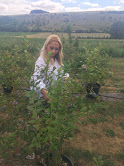
Yes,  I am wearing white to pick juicy berries - what's life without risk, and all that.
One of the common misconceptions about Britain is that it is a place where you "just can’t get decent fruit". Although inaccurate and unfair, this opinion is not simply plucked from the ether, but has some basis in reality. I will readily admit finding high quality produce might require more effort, and sometimes cost you more, than if you live in France, Italy or Poland. It is true that buying imported strawberries at the biggest supermarkets will not disabuse you of a notion that strawberries here are spongy and tasteless. (Side note - unlike some people I know, I don’t subscribe to the view that supermarkets are the devil, and I don’t romanticise „peasant” diets of our pre-supermarket past. I have yet to read a food historian who does. If you want to know more, I particularly recommend our own expert Bee Wilson’s books and articles, and American food historian Rachel Laudan’s writings, and there are plenty of other authors who have studied food systems and diets of pre-industrial societies, and agree that supermarkets, while not entirely unproblematic, have been beneficial - we have better diets than our ancestors did, in no small part thanks to modern distribution and sale systems. As the philosopher John Gray stated: every advance in human civilisation, except contraception and dental anaesthetic, has come at a price, and supermarkets are a great example of that.).
There is, in fact, plenty of good quality fruit at supermarkets, too - for example, blueberries often come from Poland, and are just as tasty as the ones you can buy in a traditional, small grocery store in a Polish town. But to make sure of high quality and flavour - and that's the crux of the matter - you have to be in a position to be able to afford shopping at a more upmarket chain, such as Waitrose, or/and to spend more. That's why Brits cast a jealous eye to France or, in case of UK-based Poles, Poland, with their street markets and small, family-run stores. Annabelle Chapman, a bilingual journalist, who writes about Eastern Europe for The Economist and lives in Warsaw, tweeted recently: "Still among my favourite things about Warsaw: so much seasonal, local, (in this case) organic food, all package-free. "along with a photo of some tempting-looking fruit and veg.

Yet we are also at an advantage here. Firstly, the fruit and veg boxes. There are several large providers and various options are readily available in most postcodes, they are convenient and a good, though more expensive, alternative to supermarkets.
But by far the best option in summer months, if you are lucky enough to live near one, is a pick-your-own. I first discovered what a PYO was in 2005, soon after we moved from London to Hampshire. The first PYO I visited is a new housing development now - there is a parable about modern England there, but I digress.
This is our nearest PYO, Ansty, which also has a farm shop and a tea room
It is thought that PYOs were invented, like so much else, by compulsively inventive Victorians, but the modern tradition goes back to the 60s. They have increased in popularity in recent years, as Brits are eating more berries than ever - it is thought that both Instagrammers' love of smoothies and the Great British Bake Off have played a part in berries recently overtaking apples and bananas as nation's favourite fruit. The market is now worth a cool one billion pounds, so if Brexit messes it up, I fully expect Insta influencers to riot in the streets. PYOs were a new concept to me as, sadly, they don't exist in Poland (at least they didn't when I lived there), but now they are as much a part of summer for me as a hose-pipe ban, Pimm's and 99 ice-cream. A family trip to the nearest pick-your-own is a summer ritual, and a delightful way to spend a Saturday. You are out in fresh air, picking fruit for yourself, so you can do it at a leisurely pace, picking only the juiciest, ripest fruit - food doesn't get fresher than that. We went last weekend and left loaded with blackcurrants, redcurrants, white and pink currants, gooseberries and blueberries.
Fruits of our labour


We have already enjoyed a redcurrant mousse (too much, as I haven't even taken a photo) and a gooseberry fool. Bursting with flavour and vitamin C, they were utterly delicious.
Are there PYOs where you live?
Gooseberry fool